The Queen Bee
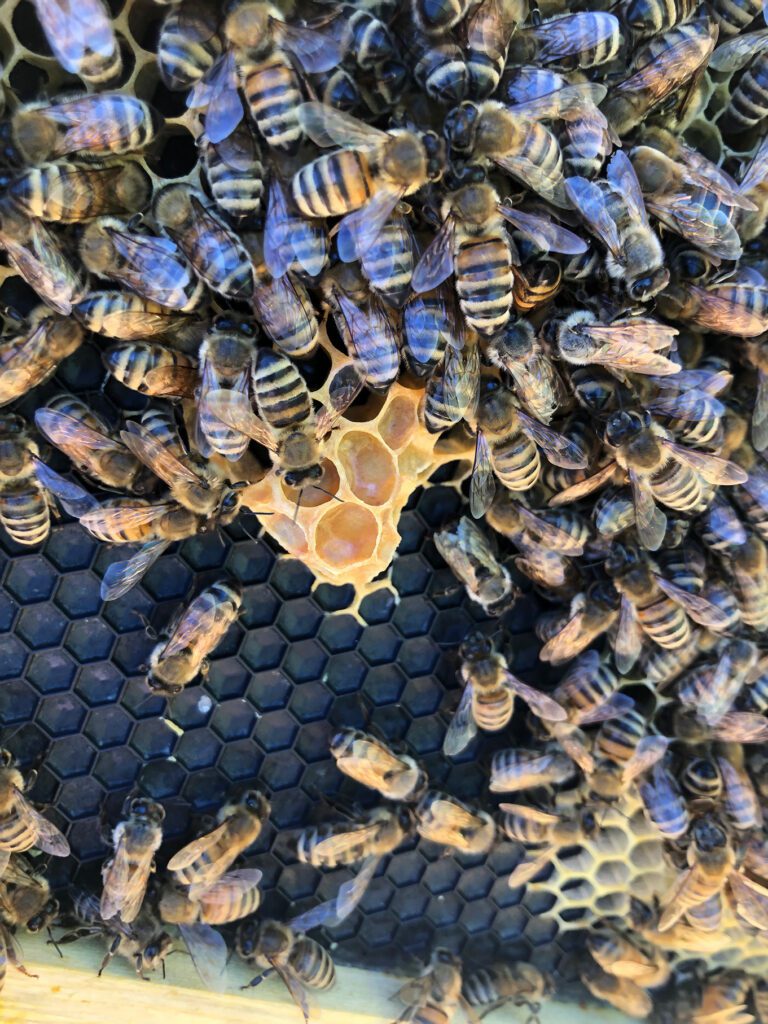
Somewhere in the undulating mass of bees is the queen. Several physical attributes set the queen apart from the workers. Her thorax is larger than workers and the black spot on the back of her thorax is bigger and shinier. Her abdomen is much longer than the workers', making her wings appear much shorter in proportion to the rest of her body. As the queen only uses her wings for her orientation and mating flights or swarming, she keeps then tucked behind her back while she's in the hive.
The queen can often be seen resting on the comb, encircled by a group of workers who are feeding and grooming her. Otherwise, she marches deliberately around on the comb, poking her head into cells, looking for suitable places to lay eggs.
Protruding from the comb, hanging vertically with the openings facing down, may be queen cups. They resemble small acorn tops and are kept by the bees in case a new queen needs to be raised, If an egg or young larvae is put into the queen cup, and the bees decide to raise it, they will build a queen cell down from the cup. The cell resembles a peanut attached to the comb. The exterior texture of the queen cell is very interesting in that it has a honeycomb-ish pattern in miniature embossed in the wax.
The Drones
Drones are raised similar to workers, except they require more resources. They are larger than workers and are raised in larger cells. The 24-day gestation period for drones is longer then four workers or queens, and they consume the most food in development. Drones can't even chew through their own cappings to emerge and must instead rely on workers to release them. For the first three days of their lives, drones can't even feed themselves.
Besides its large size and brick shape, the other noticeable feature are the drone's eyes are larger--only real active job for the drone is to catch a queen in flight to mate, which is a relatively rare occurrence. Spotting the queen in flight requires considerable visual capabilities.
The Worker Bees
Most of the hive is made up of female workers. The worker bees do most of the work around the hive. Most importantly they care for the brood comb and because the brood comb has larvae in it, worker bees --primarily house bees and nurse bees--cover the brood to keep it warm and to feed the larvae. Worker bees do many tasks in and around the brood, some of which are difficult to decipher by merely watching. Much of their energy goes to processing nectar and pollen, caring for the brood, and preparing cells for the queen to lay eggs.
