
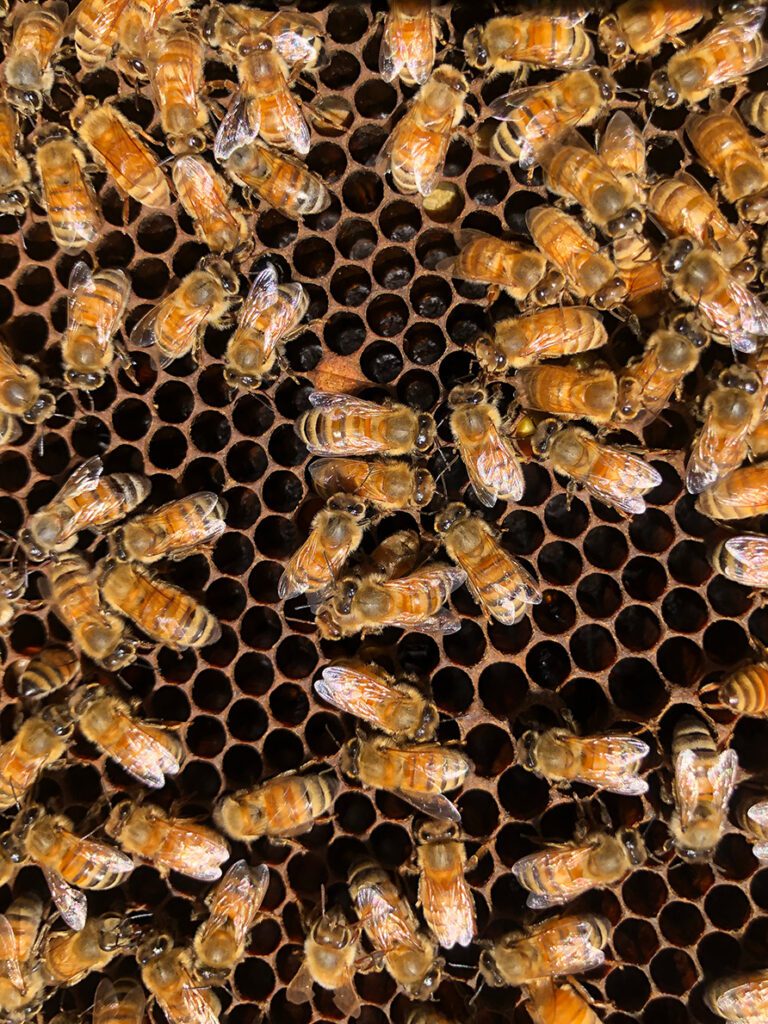
The worker bee - the bulk of the hive is made up of non-reproductive female workers. As their name implies, workers do the bulk of the work in and out of the hive, and they make up more than 80 percent of the population. Their roles are determined by their age and the needs of the colony. For instance, if all the bees assigned foraging duty (nectar, pollen, or both) disappear, younger worker bees will almost immediately take on their roles. If pollen is trapped by the beekeeper (reducing the amount of pollen brought in), the colony will assign more bees to gather pollen. But keep in mind that these are not top-down decisions. Instead, they are results of interacting and conflicting physical and chemical cues shaping the behavior of the colony one bee at a time.
Working from Birth - When a worker first emerges from her cell, she looks a little worse for wear. Her fur is matted, her color is a bit dusty looking, and she wobbles around on the comb. As she becomes stable and takes her place in the hive order, her first task is to prepare the cells, The bees, using their tongues as their tools, must clean and polish the cells before the queen can lay in them again.
Nurse Bees
After the worker's exoskeleton hardens and she matures a bit, she starts to care for the brood as a nurse bee. Using her mouthparts, she fees royal jelly to newly hatched larvae for three days. After that, worker larvae are fed a less potent mixture of the same ingredients known as brood food, bee milk, or worker jelly. Royal jelly is fed to queen larvae through their entire larval period. The source of protein for both of these foods is beebread ingested by the nurse bee and synthesized by glands in her head.
The development of the worker larva is staggering. In the six days between the egg hatching and the bees capping it over, the larva increases in weight more than 500 times with virtually no waste! During those same six days, worker bees visit each larva about 110,000 times for feeding and checking. The workers use their antennae to "smell" what each larva needs, and feed it with a custom-mixed formula.
When the young nurse bee is a little older, she graduates to comb building and capping. The bees start to fly and orient themselves as early as 4 days after emerging (while they are still cleaning cells), and by day 20 have graduated to guarding the hive entrance and foraging for nectar, pollen, and water.
The Ravages of Time and Work - In the summertime, a worker lives only about six to eight weeks. Because her body is never repaired, her wings tatter in the wind, and likely she will be outside the hive foraging when she finally has a load too heavy to lift. Very few bees die inside the hive in summer.
Cabin Fever - Winter workers are bees raised in the late fall who survive for the early pollen flows come spring. They have more fat reserves than bees raised during other times of the year and likely live longer because, for the most part, they don't expend a lot of energy raising or producing food for the brood. The incredible nutrition worker bees produce for the brood takes a serious toll on their bodies.
