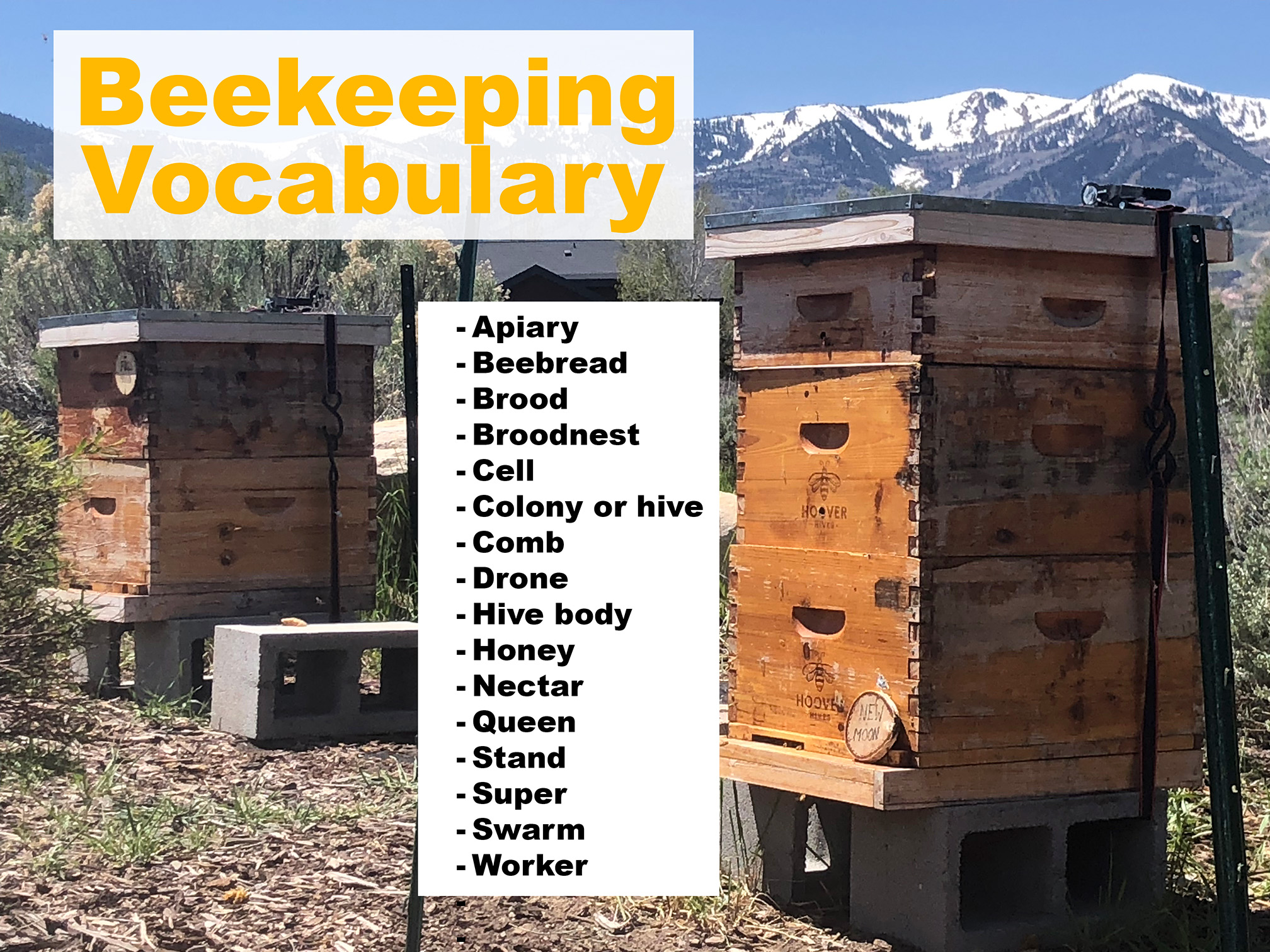
I'm fairly new to beekeeping, and I joined a company where we manage over 70 local beehives. I jumped in quick and learned there is a Beekeeping Vocabulary. Calling a Super the box thing doesn't communicate very well. Occasionally you may have to buy something like a frame for your hive, knowing that it's called a frame is important when you go to purchase the replacement from the local supply shop for beekeepers. It is important to become familiar with some words used in the beekeeping world.
Apiary
A yard with beehives on it; a bee farm.
Beebread
Fermenting pollen that is packed into cells. Beebread is the protein source for the entire colony, and the building material for raising new bees.
Brood
Young bees in every stage of development from the time the eggs are hatched to when the adult bee emerges.
Broodnest
The area in the combs where eggs are laid and brood is raised. The broodnest generally occupies the center of the hive over multiple combs.
Cell
One of the many individual hexagonal wax tubes that make up the comb.
Colony or hive
A self-contained group of bees that live and work together. Hive can refer to the bees and the structure, or just the structure used to house the bees. A healthy colony of bees can contain between 15,000 and 100,000 individuals.
Comb
A sheet of horizontally oriented beeswax with hexagonal tubes that bees use for producing and storing honey, storing and fermenting pollen, rearing their brood, and living, Comb has two similar sides, and the sides are offset from one another for maximum strength.
Drone
The male honeybee. The drone is large, has no stinger, and is produced from an unfertilized egg (and therefore has no father). Drones have the longest gestation period (24 days) of all the castes, or types, of bees.
Hive body
Any one of the single boxes full of frames in a modular stack of boxes that makes up the hive and houses a single colony.
Honey
Produced from nectar by both evaporating out most of the water, and via enzymatic transformation by microbes living in the bees themselves. honey is food/energy storage for the honeybee colony for both the long and short term.
Nectar
The sugary substance produced by flowers in order to attract pollinators. Bees collect nectar and transform it into honey.
Queen
The Queen Bee - reproductive female of the hive. She lays all the eggs, and is mother to all the bees born in the colony. Queens develop very quickly (probably due to the incredible amount of protein in their diet), and emerge 16 days after the egg is first laid. A newly emerged queen must first take orientation flights of increasing lengths so that she can learn how to get back to her colony. Eventually (a week or two after emerging) she will go on one or more mating flights to transform from a virgin (unmated) to a laying (mated) queen. During her mating flights she will mate with up to 30 drones. There is generally only one laying queen in the hive (although it isn't uncommon to find a mother and daughter both laying), and virgins will fight to the death with one another, and even sting not-yet emerged queen in their cells.
Stand
A support that one or more hives sits on.
Super
A box that holds frames for honey production by the bees, also known as honey super. It is placed above the broodnest. Note that hive body and super are sometimes used interchangeably.
Swarm
When some (not all) of the bees, including a queen and workers, leave the original colony to establish a new colony. Swarming is the reproduction of a colony into tow colonies. Swarms have no resources to protect (comb, food stores, brood), and tend to be extremely passive and nonaggressive.
The Worker Bee
The worker bee makes up the vast majority of bees in the hive. Workers are non-reproductive females who do all the work in the hive besides laying eggs. Workers (and queens) are both raised from fertilized eggs; the difference in development has to do with the diet each is fed. Workers develop from newly laid eggs into adults in 21 days.
By getting familiar with the Beekeeping Vocabulary, managing your bees becomes easier. If you'd like help managing your bees get ahold of us at root revival in Park City Utah.
Expanded Bee Vocabulary
Drawn comb
Fully formed honeycomb. Bees can draw comb from foundation or in an empty space.
Foraging
Finding and eating food. Honeybees' forage can include nectar (to make honey), pollen (for beebread), water, and plant resins (to make propolis).
Foundation
A sheet of beeswax or plastic used as the basis on which comb is drawn. It is embossed with hexagons, thereby giving the bees a "foundation" for building cells. Most beekeepers use foundation.
Honeyflow
Period in which there is abundant nectar available for forage.
Honey Super Cell
A plastic frame with fully constructed plastic comb. This differs from foundation in that the comb need no be drawn; it is molded out of plastic.
Propolis
Bee product made from plant resins and used by the bees as glue, plaster, as a disinfectant, as well as to reinforce and stiffen comb.
Queen Excluder
A mesh screen placed at the entrance of a hive box that allows workers to get through, but prevents passage by queens and drones (who have larger thoraxes).
Royal Jelly
A protein-rich formulation of bee milk mixed with regurgitated carbohydrates and fed to queen larvae.
Bee Milk
Is produced from glands in the nurse bee's head and requires that the nurse bee feed on protein-rich pollen/beebread. Although royal jelly is often sold for human use, its production is extremely labor intensive.
